

Your Best New Revenue Is
Already in Your CRM:
How Mature Companies Should
Be Using AI to Grow From Within
June 22nd, 2027
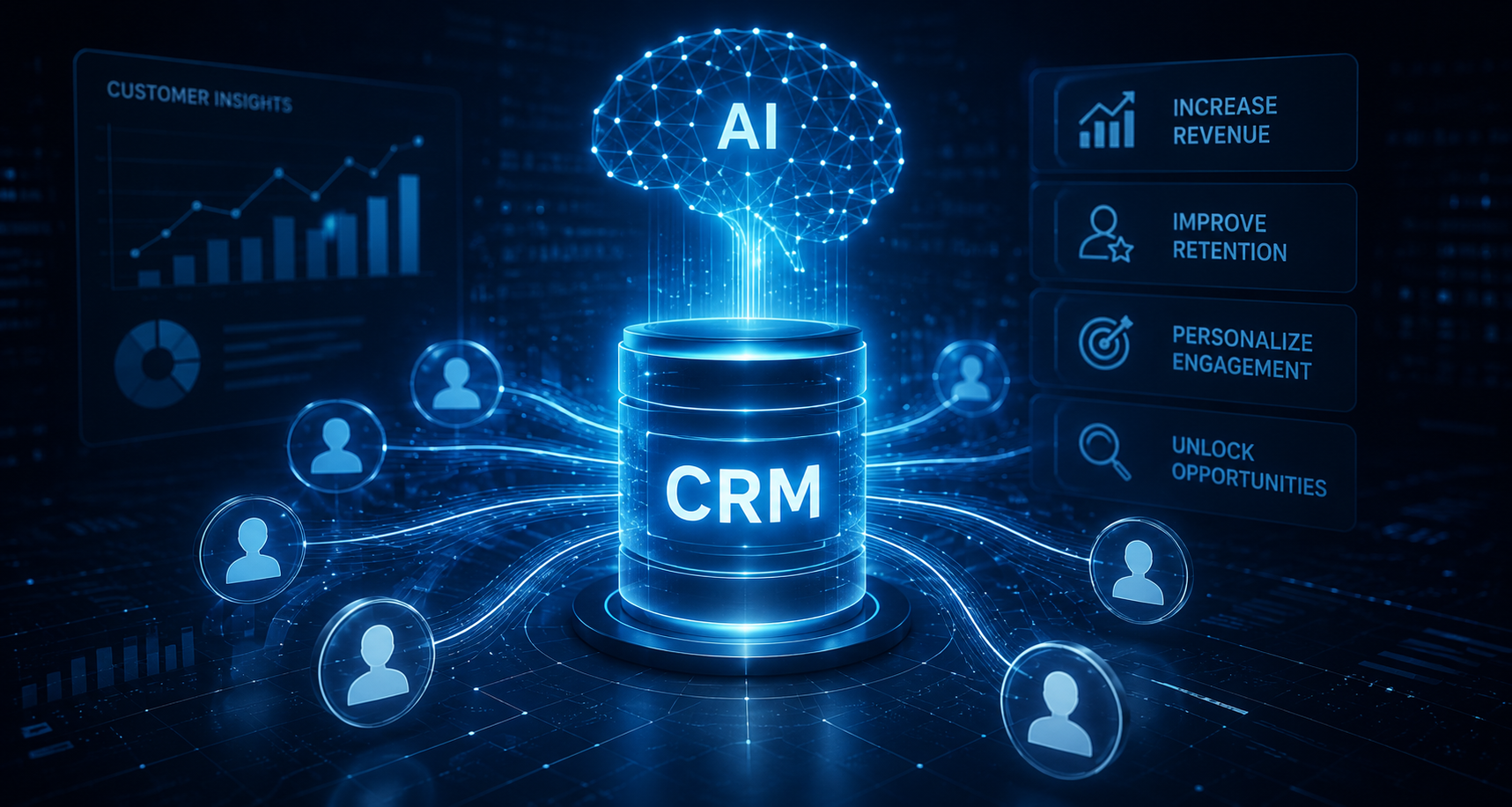
Most established businesses are sitting on their most valuable asset without realizing it. Your existing customer base isn't just a revenue stream. It's an intelligence layer waiting to be activated.
There is a particular kind of blindspot that affects mature, successful companies. It's not a lack of data, talent, or resources. It's a failure of imagination about what those things can now do.
For years, growth meant acquisition: more marketing spend, more sales headcount, more channels. But the economics of acquisition have become punishing. CAC is up across nearly every industry. Attention is fragmented. The return on chasing new customers, in many verticals, has never been worse.
Meanwhile, sitting quietly inside most established companies is one of the most underutilized assets in business: a deep, longitudinal database of existing customers: their behaviors; their needs; their patterns; their moments of friction; their problems in need of an unmet solution.
And for the first time in history, AI gives you the tools to do something genuinely transformative with all of it, if you know what to look for.
The Acquisition Trap
Most later-stage companies still think about growth the way they did when they were scaling: primarily as a function of bringing new customers in the door. It made sense at the time. Early growth is almost entirely about expanding the base. But somewhere along the way, the playbook stops getting updated. The acquisition machine keeps running because it's familiar, not because it's still the best use of capital.
The numbers tell a different story. Selling to an existing customer is dramatically more likely to succeed than converting a new one. Existing customers spend more, churn less, and refer more often. They've already cleared the hardest hurdle: trust. The question isn't whether they represent an opportunity. The question is whether you're actually doing anything intelligent with what you already know about them.
The companies winning the next decade aren't the ones acquiring the most customers. They're the ones extracting the most value from the relationships they've already earned.
“Your existing customer base isn't just a revenue stream. It's an intelligence layer waiting to be activated.”
Christian Pusateri
What AI Actually Unlocks, and Where Most Teams Fall Short
When executives talk about using AI in their business, the conversation usually defaults to automation: replacing manual tasks, speeding up workflows, cutting headcount. Those are real applications, but they're the floor, not the ceiling.
The more durable opportunity is in intelligence: using AI to understand your customer base at a depth and speed that was previously impossible, and then building products and services that serve what you now understand. Here are six areas where mature businesses are leaving the most on the table:
Behavioral segmentation: AI can cluster your customer base by actual behavior, not just demographics, and reveal distinct segments with distinct needs that your current product suite may not be serving at all.
Churn prediction & intervention: Predictive models trained on your own historical data can identify at-risk customers months before they cancel, giving your team the window to intervene with precision, not guesswork.
Product gap discovery: Patterns in support tickets, usage drop-off, and feature requests contain an honest product roadmap. AI surfaces what your customers actually want before they go find it elsewhere.
Personalized expansion: Rather than broad upsell campaigns, AI enables surgical cross-sell offers triggered by the right customer behavior at the right moment, dramatically improving conversion without increasing spend.
New product development: Your customer database is a market research engine. The signals inside it can validate or kill new product ideas faster and more accurately than any focus group or survey.
Lifetime value optimization: AI models can identify the customer journeys that produce the highest LTV, allowing you to reverse-engineer and replicate those conditions across the broader base.
What Does That Look Like?
If you are wondering what it might look like to capitalize on your existing CRM, consider an example.
Consider a B2B SaaS company that has been operating for seven years. They sell a workflow automation platform to mid-market operations teams with a solid product, a loyal customer base, $40 million in ARR, and a net revenue retention rate that looks acceptable on paper but has been quietly plateauing. The sales team keeps chasing net-new logos because that's what the growth narrative demands. Meanwhile, the existing customer database, with thousands of accounts that each note years of usage data, support history, and behavioral signals, is largely untouched as a strategic asset.
Inside that database is a map of exactly what their customers actually do with the product versus what they were sold. Some cohorts use three features heavily and ignore the rest. Others have built workarounds inside the platform that signal an unmet need that a new module or integration could solve natively. A subset of high-usage accounts have never been offered an enterprise tier, not because they wouldn't qualify, but because no one ran the analysis to identify them. Churn, when it happens, follows a pattern that only becomes visible in retrospect: a dip in login frequency six weeks out, followed by a drop in API calls, followed by a support ticket that goes unresolved for more than four days.
With an AI layer applied to that behavioral data, this company could build a living early-warning system for churn, a precision expansion model that identifies upgrade candidates before they self-select, and a product roadmap informed by actual usage gaps rather than loudest-voice-in-the-room feature requests.
More ambitiously, the usage patterns across their customer base contain enough signal to validate an entirely new product line, such as a lightweight analytics layer, a partner integration marketplace, or an AI-assisted workflow builder that can target the segment their data reveals is most underserved. The net-new logo chase doesn't stop. It just stops being the only lever. And in a market where CAC keeps climbing, that distinction is worth tens of millions of dollars.
The data was always there. The intelligence to act on it is what's new.
Building New Products from Existing Signal
The most ambitious version of this opportunity isn't simple optimization; it's expansion. Established companies with large customer bases have something most startups would pay dearly for: a captive audience with known needs and existing trust. That is an extraordinarily valuable foundation for launching adjacent products and services.
But new products fail for predictable reasons. The idea sounds right internally but hasn't been validated against real demand. The TAM is assumed rather than assessed. The positioning is built for the company's internal logic rather than the customer's actual problem. The go-to-market is an afterthought.
These are exactly the failure modes I help companies avoid. When I work with a mature business on expanding its product suite, I'm doing more than advising. I'm operating alongside the team to hone the product concept, rigorously assess the addressable market, define the narrative, and build the go-to-market motion from the ground up. Then we see how it plays out, and adjust as events dictate until we succeed. The same work I do for early-stage founders applies here, with one crucial difference: you already have the distribution. You already have the trust. The question is whether you have the clarity and vision to act on it.
The Window is Open, But It Won't Stay That Way
The companies moving fastest on this right now are the ones that will own their categories in five years. AI is not a future capability; it is a present one. And the gap between businesses that are deploying it intelligently against their customer data and those that are not is widening every quarter. The tools exist. The data exists. What most organizations lack is the strategic know-how and go-to-market expertise to turn that raw material into real revenue.
That's the work Tao of Data was built for. Not to sell you a technology platform, not to audit your data infrastructure, but to sit inside your business, understand what you actually have, and help you turn it into something that compounds into optimal value and revenue.
If you're running an established business and you're not sure whether you're getting full value from your customer base, or if you have a product expansion in mind and need someone to help you do it right, let's have that conversation. The signal is in your data. The question is what you're going to build with it.